Hiring & Planning
How to Check a Contractor’s License, Insurance, and Identity
Verify the contracting entity, applicable license, current coverage, permit responsibilities, and the limits of ownership or verification labels.
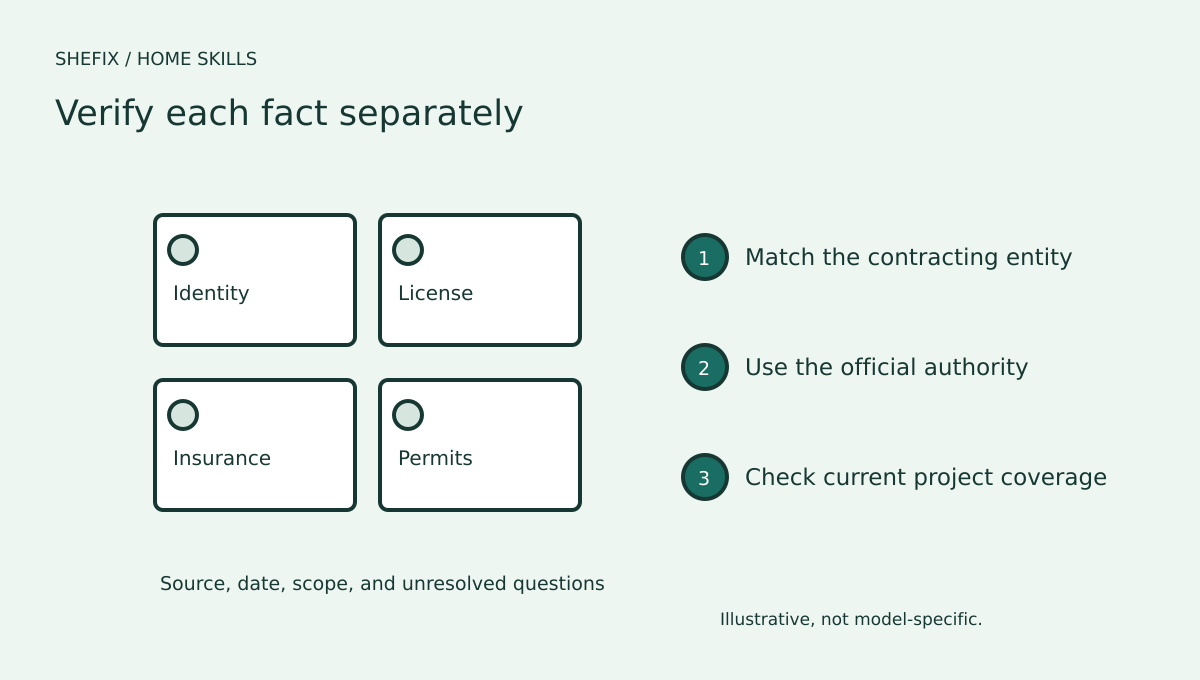
A business name, a polished website, and a confident claim of licensed and insured are starting information. A homeowner needs to verify the credentials relevant to the actual work, location, business entity, and time of the project. Ownership, licensing, insurance, permit responsibility, and references answer different questions. Do not let one positive signal stand in for all the others.
Requirements vary by trade and jurisdiction. This guide explains the checking process without claiming that every household service requires the same license or insurance. Use the current official authority for your location and ask for professional advice where the requirements are unclear.
Identify who will contract with you
Ask for the legal business name, any trading name, address, license number where applicable, and the person responsible for the work. Match those details with the proposal and contract. A license belonging to an unrelated person is not a substitute for the appropriate credential arrangement for the contracting business.
Find out whether employees or subcontractors will perform the work and who supervises them. Ask which entity carries responsibility for those workers and how any subcontractor credentials will be checked. Save the answer in writing rather than assuming the company logo covers every arrangement.
Ownership is a separate check. A women-owned business may provide self-reported information, registry records, certification, or other evidence. Each source establishes something specific and may have limitations. Do not infer ownership from a first name, photograph, or the gender of the person answering the phone.
Verify the applicable license at the source
Use the relevant official licensing or registration portal rather than relying only on a copied badge. Search by the stated number and business or individual name. Compare the status, scope or classification, dates, and identifying information that the authority provides.
For Florida regulated professions, DBPR provides an official license search. Some requirements are handled by other authorities or local jurisdictions, so the absence of a result in one portal does not answer every licensing question. Contact the appropriate authority if the classification or requirement is unclear.
Check insurance for the actual project
Ask for current insurance documentation relevant to the work and entity. Understand what the document identifies, its dates, and its stated coverage. A certificate alone may not explain exclusions, whether a particular activity is covered, or how workers are treated.
Where appropriate, confirm details through the agent, insurer, or other reliable source using independently verified contact information. Ask the professional how damage, injuries, subcontractors, and claims would be handled. Do not assume a general liability policy answers every workers' compensation question.
Coverage and legal requirements vary. If the work is substantial or unusual, consult an appropriate insurance or legal professional about what you need to see. The goal is a relevant current check, not collecting a PDF simply to fill a folder.
Establish permit and inspection responsibility
Ask the local building department whether the proposed scope needs a permit and which jurisdiction controls the address. A postal city may differ from municipal boundaries. Association approval and a government permit are separate requirements.
Clarify who applies, whose name appears, who schedules inspections, and how completion will be documented. Be cautious if someone asks you to take on an owner-builder role you do not understand. Do not assume that a contractor's statement that no permit is needed is the final authority.
Save permit numbers and inspection records when applicable. At the end of the project, ask whether permits have been appropriately completed or closed. Unresolved paperwork can become a later issue during another repair or property transaction.
Use references as a different kind of evidence
Ask about projects similar to yours, with permission to contact references. Useful questions concern scope, communication, handling of changes, schedule, cleanup, and follow-up. A glowing review of a small service call does not establish experience with a major renovation.
Online reviews can provide context, but they may be incomplete or unverified. Read for specific patterns rather than relying on a single rating. Ask how the business responds to a problem after completion.
Understand SheFix status labels
Read the profile's current status and evidence details. An unclaimed public listing means the business has not yet claimed that listing. A claimed listing means the account relationship is established. A verification label should be understood by its stated scope, evidence, date, and expiration.
A paid plan or featured position does not prove craftsmanship, current insurance, or project suitability. Confirm the facts that matter to your own work. SheFix helps organize discovery and project information; you remain responsible for the hiring decision.
Questions homeowners ask
Is a screenshot of a license enough? Check the current record at the official source where possible. Status can change after a screenshot was taken.
Does women-owned mean licensed? No. Ownership and occupational credentials are different facts.
What if a document expires during the project? Ask how current coverage or credentials will be maintained and documented. Resolve it before the relevant work continues.
Save what you actually checked
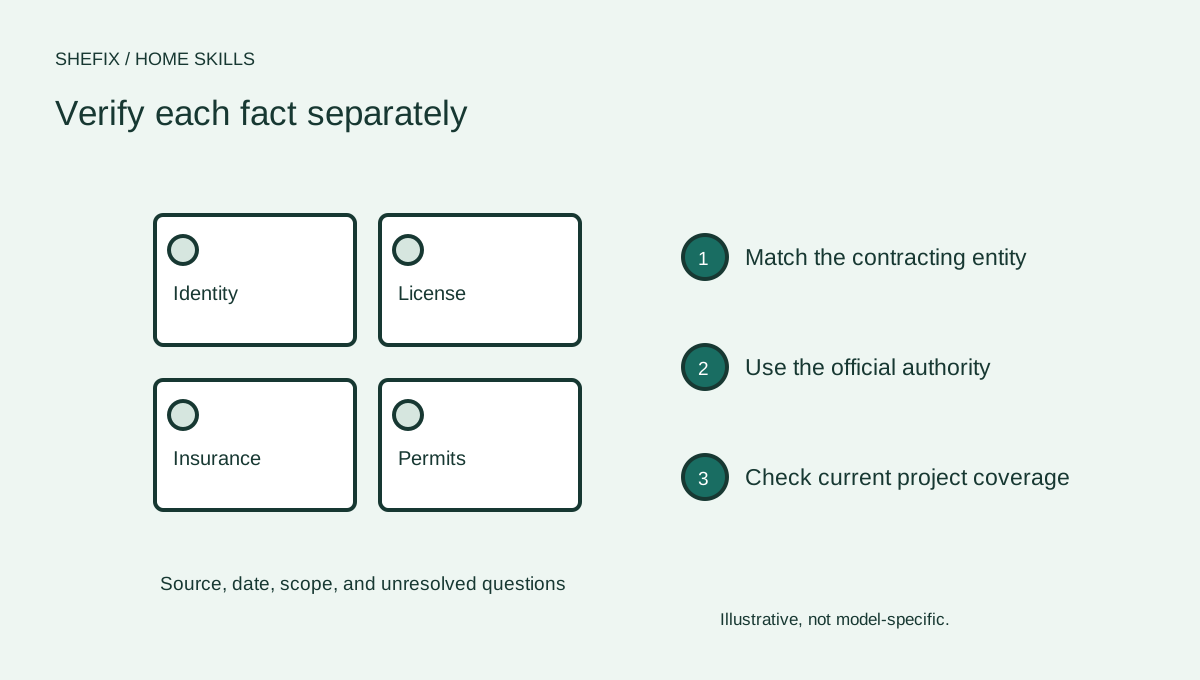
Record the source, date, identifier, result, and unresolved questions. Keep the documents beside the accepted estimate and contract. That record is more useful than a folder labeled verified with no explanation of what the label means.
Your printable project checklist
Use your browser's PDF option to keep a copy. Create a free account to keep project records and compare professionals.
Sources & further reading
Follow the instructions for your specific equipment and confirm current local requirements.